
Ten years ago, the word "biophilic" was something architects said to each other at panel discussions; today it is something homebuyers quietly check for when they walk a site. The shift has been subtle and then all at once. What used to be a small palm on the podium and a water wall in the lobby has become a full design grammar — plant-lined breezeways, timber that was never painted over, stone that was allowed to show its veining, a sight line to a tree from every sofa. In the Indian luxury market, and especially in the Delhi-NCR extension, this grammar has moved from a nice-to-have to a non-negotiable. Biophilia is the new baseline.
It is easy to read that as fashion. It is more accurate to read it as recovery. Between 2015 and 2024, a generation of urban Indian buyers lived through the twin compressions of the pandemic and the worsening air quality crisis, and emerged with a very different brief for their homes than the one their parents wrote. They do not want a trophy. They want a refuge. Biophilic design, properly done, is the architectural vocabulary of that refuge.
What biophilia actually means in a tower
The term "biophilia" was popularised by the biologist E. O. Wilson to describe the innate human affinity for living systems. Translated into architecture, it asks a simple question — how do we design a building so that people inside it feel connected, moment to moment, to the natural world. In a low-rise villa this is easy. In a thirty-five storey tower in a polluted Indian city, it is an engineering problem.
The answer, increasingly, has two sides. On one side is the choreography of nature into the built form: the deep balconies that can hold a real tree rather than a pot, the double-height lobbies that frame a living green wall the height of a two-storey house, the corridor windows that open to sky instead of another corridor. On the other side is the choreography of air, light and sound so that the biophilic elements do not have to fight against a hostile microclimate. You cannot plant a tree on a balcony where the AQI is 400 and expect it to thrive, and you certainly cannot expect the resident to sit under it.
This is why the recent generation of serious Indian luxury projects have started treating biophilia and engineering as one brief rather than two. The plants are part of the mechanical system. The mechanical system is part of the visual design. The result is a home that reads as green even when the city outside is grey.
The Fab Luxe reading of biophilia
Forbes Fab Luxe Residences at Sector 4, Greater Noida West, is a useful case study because the biophilic intent is written into the site plan rather than sprinkled over it as finish. The thirteen-acre estate is organised around a series of landscaped ground-plane gardens — Oxygen Parks and microforests — that are deliberately sized not as ornamental strips but as real canopies. The intent is that a resident walking from the tower lobby to the clubhouse passes through something that reads, at eye level, as a garden and not as a corridor.
Eleven towers in a G+35 configuration sit on that ground plane. Because the project reserves only four homes per floor, the floor plates are narrow enough to let cross-ventilation happen without compromising privacy, and the apartments can be oriented so that the primary living and bedroom spaces look over green rather than over neighbour. The 3 BHK + Study at around 2,690 sq ft and the 4 BHK + Study at around 3,307 sq ft both carry generous balcony depths that are specified to hold planters large enough for real shrubs and small trees, not decorative pots.
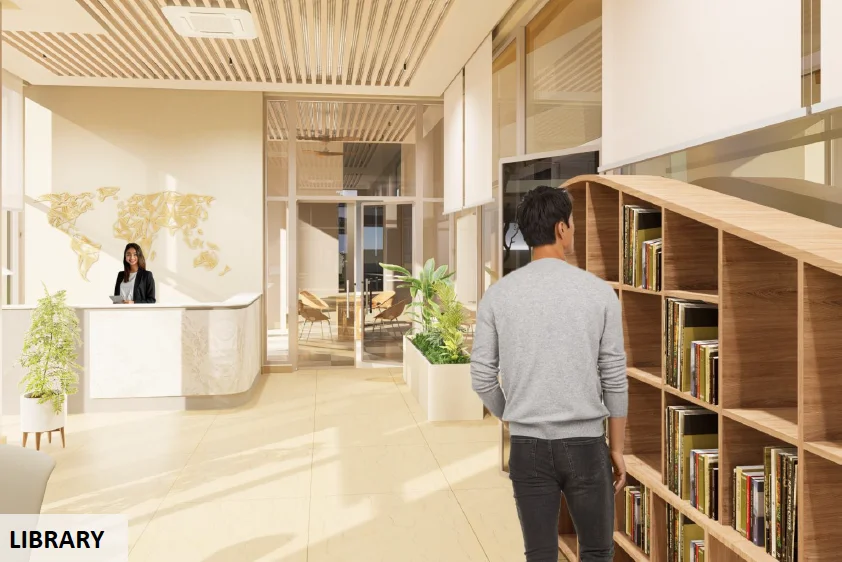
Material choices reinforce the same reading. Timber finishes are used in spaces where residents linger — the sit-out corners of the clubhouse, the reading nooks, the study. Stone is specified with visible grain rather than polished into uniformity. Water features are positioned at the approach to common spaces, close enough that you hear them before you see them, which is the oldest biophilic trick in the book and the most reliably calming.
Why the AQI story matters here
It would be easy to treat biophilia as purely aesthetic. The Indian condition makes that impossible. For biophilia to work in Delhi-NCR, the AQI inside the home and the campus has to be manageable enough that residents actually open the window, use the balcony, and sit under the tree. This is why Fab Luxe is marketed as India's first AQI-managed luxury tower — the biophilia brief only delivers if the air brief delivers first.
The twin-stage HEPA and activated-carbon filtration specified across the towers, the fresh-air systems in every room, and the campus-scale interventions like high-pressure mist cooling corridors and anti-pollution sprays are all, in effect, in service of the biophilic proposition. They make it possible for a resident to walk their child through the Oxygen Park in January without reaching for a mask, and for a balcony plant to survive the winter.
Seen this way, the AQI infrastructure is not a separate luxury feature. It is the enabling technology for a kind of life that biophilic design has always promised but Indian cities have rarely delivered.
The amenity layer: sixty-four ways to touch nature
One measure of how seriously a project takes biophilia is how the amenity programme reads. At Fab Luxe the sixty-four-plus amenities are deliberately split between the indoor clubhouse and the outdoor landscape. The outdoor amenities include an arboretum-style walking loop, water bodies, a herb garden, an outdoor reading pavilion, a yoga deck sited under tree cover, a cricket pitch on real turf, and a children's play zone integrated into the garden rather than fenced off on a concrete pad.
The indoor amenities — the gymnasium, the spa, the co-working floor, the screening room — are each positioned with at least one full wall of glazing opening onto landscape. This is a small decision on the plan but a defining one in use. A yoga class with a view of a canopy is a different experience to a yoga class with a view of a wall.
What to look for as a buyer
If you are evaluating a luxury project through the biophilic lens, the brochure language is almost useless — every developer now claims to have a "green" scheme. The questions worth asking are architectural.
First, how much of the ground plane is genuinely soft-scaped versus paved-then-potted? Real biophilia needs soil depth. Second, how deep are the balconies, and are the drainage and slab loads specified to carry planters large enough for actual shrubs? Third, is there a fresh-air delivery system sized to let windows remain closed during high-pollution weeks without the apartment feeling stale? Fourth, is the landscape plan by an actual landscape architect with a residential portfolio, or is it a by-product of the architect's site plan? Fifth, and most telling, how are the sight lines from the living room and the primary bedroom set up? A view of a tree is worth more than a view of a skyline you cannot afford to open the window for.
At Fab Luxe, these questions resolve in the right direction. The landscape is anchored in the ground plane rather than the podium. The balconies are sized for planting. The fresh-air system runs into every room. The sight lines are drawn to green. It is a project designed by people who read biophilia as a discipline rather than a decoration.
The economics of quiet green
A common objection is that biophilic luxury is expensive, that trees on a ground plane cost more than podium cover on top of a basement, that real landscape architects are more costly than a bolt-on green wall supplier, that HEPA-grade fresh air infrastructure adds a non-trivial sum to the per-unit cost. All of this is true. What is also true is that the buyer who is in the market for a 2,690 sq ft 3 BHK + Study at Fab Luxe is a buyer who has already internalised the cost. They are no longer paying for square feet. They are paying for a kind of life. The biophilic layer is, in their mental model, the difference between a wellness home and a warehouse with a granite floor.
Pricing at the project is on request, as is standard for launches at this spec level, but the discipline of the brief — 13 acres, 11 towers, only 4 homes per floor, G+35, 632 residences in total, Dec 2028 possession, NBCC monitored and under Supreme Court oversight — signals a developer that has chosen to build fewer, better apartments rather than more, cheaper ones. That is, quietly, a biophilic choice too. Density is the opposite of biophilia. Restraint is biophilia's closest ally.
The new baseline
The honest conclusion of this shift is that biophilic design in the Indian luxury segment has stopped being an amenity. It is an expectation. Buyers do not ask whether there will be a green wall; they ask how deep the soil is behind it. They do not ask whether there is a jogging loop; they ask what trees will shade it in May. They do not ask whether the home has cross-ventilation; they ask what the AQI will be when the windows are open.
This is what it means for a baseline to move. Developers who are still selling "green" as a feature will spend the next five years watching the serious money walk past them toward developers who treat green as infrastructure. Forbes Fab Luxe Residences is in the second camp. Its biophilic scheme is not a marketing line. It is the project.
If you want to understand what the new baseline looks like in practice, read our complete guide to the project, or book a walk of the model experience centre. A photograph is not a walk. A walk is not a life. But a walk, at least, tells you whether the brief is serious.