
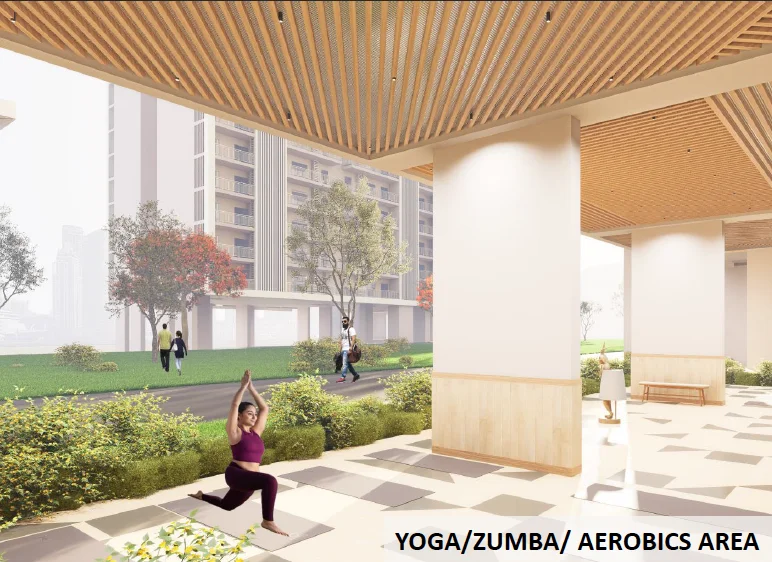
There is a moment in a site visit, usually five minutes in, when the brochure begins to contradict the building. The brochure claims a "wellness" ethos. The building, at its core, is a concrete shell with a Pilates studio bolted on. The resident who buys that apartment spends the next decade learning what the brochure left out — that the gym is noisy because the slab above the gym is also the slab below their bedroom, that the spa has no natural light, that the jogging track is a painted line on the driveway, that the air-conditioning recirculates dust, that the windows were never specified to close properly. Wellness, as so much of the Indian market understood it until recently, was a room. In 2026, in the serious projects, wellness is a brief.
This essay is an attempt to describe the difference. Not because anyone needs convincing that wellness matters, but because most buyers are still being sold a gym when what they actually want is a building that does not make them unwell.
The shift from amenity to architecture
Wellness architecture, properly understood, is a structural discipline. It asks: where does the air come from, where does the light fall, how does sound travel, what do you walk on, what do you see when you wake up, how far is the lift from the bed, how warm is the floor in January, how clean is the water in the tap. These are not amenities. They are design decisions made at the plan stage, and they are almost impossible to retrofit.
The amenity-era wellness home said: here is a spa, here is a yoga studio, here is a salt room. The architecture-era wellness home says: here is a building whose air, light, acoustics, thermal comfort, water, movement patterns and sight lines are tuned so that a resident who never walks into the spa still feels, by evening, that the day has been kinder to them than a day in a standard apartment would have been. The spa is a bonus. The building is the point.
Air is the first wellness decision
In Delhi-NCR, air is the wellness decision. Every other wellness feature downstream of it is compromised if the air brief fails. This is why the most consequential wellness decision at a project like Forbes Fab Luxe Residences is not a feature in the clubhouse — it is the AQI infrastructure across the campus and into every apartment.
The specification reads, in editorial shorthand: outdoor air actively managed through mist-cooling corridors, anti-pollution sprays, anti-dust pavements, AQI-shielded play zones, and Oxygen Park microforests; indoor air managed through twin-stage HEPA and activated-carbon fresh-air systems supplying filtered air into every room rather than recycled indoor air; UPVC insulated windows that prevent unfiltered air infiltration; auto cut-offs that cannot be accidentally disabled. This is not a gym. It is an operating condition. It runs whether or not you go to the gym. It determines how you sleep, how your child's lung develops, how your parents' cardiovascular system behaves through a January in the NCR.
Every wellness conversation about this project should start there, because every other wellness conversation is conditional on it.
Light, acoustics, thermal comfort
After air comes the triad that quietly decides whether a home feels like a refuge: light, acoustics, thermal comfort. Each is a design brief, not a feature.
On light — the serious wellness projects are now specifying apartment orientation and window-to-wall ratio with circadian rhythm in mind. The objective is to give the resident a body of morning light in the primary living spaces and a body of warm evening light in the bedrooms, and to avoid sun-trapped west-facing living rooms that overheat in summer. Fab Luxe's narrow floor plates with only four homes per floor allow this level of orientation control. The 3 BHK + Study and 4 BHK + Study layouts both prioritise dual-aspect living spaces. A more detailed reading of this is in our essay on the psychology of light in luxury interiors.
On acoustics — the unglamorous wellness feature. No one photographs a floor slab, but the thickness of the slab, the wall-to-wall acoustic detailing, the floating floor in the gym, the double-glazing in the bedroom window and the ceiling specification in the corridor decide whether your home is restful or not. Serious projects now commission acoustic consultants at the design stage. Our essay on acoustic privacy takes this further, but the short version is: if a developer cannot tell you their STC rating and their impact-insulation class, they have not thought about acoustics. Fab Luxe has.
On thermal comfort — the climate in Greater Noida swings hard from 45°C summer to 4°C winter. Thermal comfort in that swing is not delivered by air-conditioning alone. It is delivered by building envelope — insulated walls, UPVC double-glazed windows, high ceilings, cross-ventilation, thermal-mass stone flooring in select rooms, and a deep balcony that shades the primary glazing in summer and admits low winter sun. The Fab Luxe spec sheet reads correctly on all of these.
Movement, water, food
The next layer of wellness architecture is about the daily pattern of the body through the home and the campus.
Movement means that the geometry of the campus encourages walking — not on a token jogging track beside the driveway, but through landscape. At Fab Luxe the thirteen-acre site is organised so that a resident walking from their tower lobby to the clubhouse, to the cafe, to the co-working floor, naturally covers a kilometre through gardens. The jogging loop is in addition to this. The small, invisible decision — that the convenience store is a three-minute walk rather than a three-minute drive — is more consequential for daily health than the Pilates studio.
Water means the quality at the tap, not the decoration at the lobby. Serious wellness projects specify RO and UV treatment at the building plant rather than at the kitchen sink, hot water at the pressure that makes a real shower possible, and soft water in the bathrooms where hard water would otherwise degrade skin and hair over years. These are boring engineering decisions. They are also wellness decisions.
Food means that the project has thought about where you eat when you do not want to cook. The best residential developments are building clubhouse cafes that are good enough that residents actually use them, which in turn means the resident eats a home-adjacent meal rather than ordering a delivery from an unknown kitchen. The evolution of clubhouse design essay addresses this in detail.
The wellness programme at Fab Luxe
Taken together, the wellness reading of Forbes Fab Luxe Residences is unusual for an Indian project at this scale. It is not marketed as a "wellness project" in the slogan sense. It is designed as one in the engineering sense. The signals are quiet.
Eleven towers on 13 acres at G+35, with only 4 homes per floor, means density low enough for every apartment to carry cross-ventilation and an unshaded balcony view. 632 residences across the estate, rather than the typical 1,200 at a comparable land parcel, is a wellness decision disguised as a planning decision. The sixty-four-plus amenities are split between indoor clubhouse and outdoor landscape so the wellness programme is not locked behind a single door. NBCC monitoring and Supreme Court oversight of the construction process are, in their own way, wellness decisions — because the least wellness-generating thing in the world is a home whose structural integrity you have to worry about.
What "getting it right" looks like
If you are evaluating a project on its wellness bona fides in 2026, the useful test is a day in the life. Pick a Tuesday in late January — worst-case Delhi-NCR AQI, worst-case temperature swing, a weekday when the home has to work. Walk through it in your head from 6am to 11pm. Where does the morning light reach at 7am? Is the bedroom quiet enough to sleep through an ambulance on the nearest road? Can the child play outside between 4pm and 6pm without a mask? Is the water in the shower soft enough that your skin does not itch by March? Is the gym accessible without getting into a car? Can you finish dinner without the delivery driver ringing a bell next to your bedroom wall?
The projects that answer these questions well are rare. The projects that even ask them are rarer. Forbes Fab Luxe Residences is one of the few in its cohort that reads as a building designed by people who have lived in an NCR apartment and disliked most of what they found. The wellness layer is not an add-on. It is the correction.
For a complete reading of the project, our cover essay is the best starting point. The shorter version, for a buyer evaluating wellness seriously: ask whether the wellness brief lives in the floor slab and the window frame, not in the gym and the spa. That is what the best luxury residences are quietly getting right in 2026.