
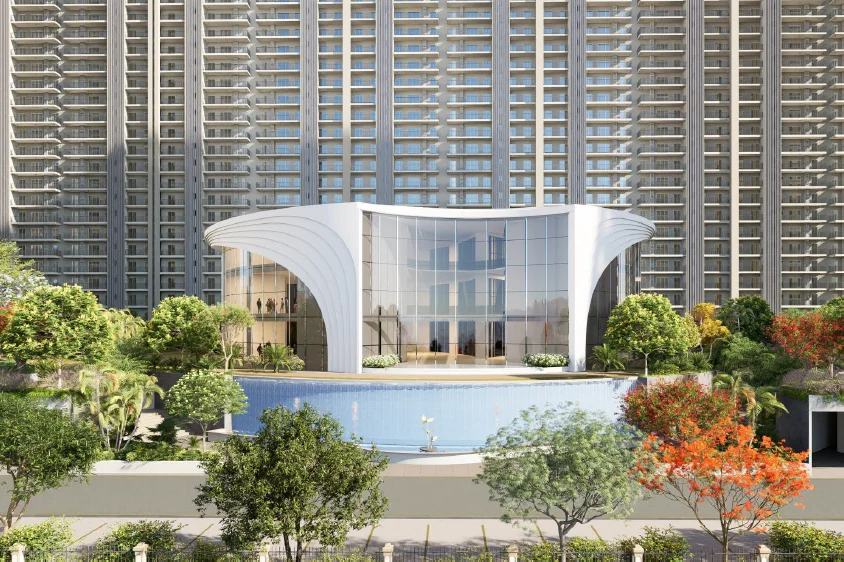
The clubhouse in an Indian luxury residential project has, over thirty years, evolved from a room with a ping-pong table to a multi-floor building that functions, on a good day, as the social operating system of the development. This evolution has happened in three broad waves, and the cohort of projects launching in 2026 — Forbes Fab Luxe Residences among them — represents the beginning of a fourth. This essay is a reading of those waves and an argument about what the next decade of clubhouse design in India will look like.
Wave one: the room with the table
In the early 2000s, the clubhouse was a marketing concession, not a design discipline. It was a room — sometimes two — at the edge of the site plan, containing a billiards table, a card table, a television tuned to cricket, and a small air-conditioner that struggled. Residents rarely used it. The clubhouse existed to tick a box in the project brochure. Its most honest name was "recreation room."
The failure mode of this wave was cultural. Indian residents, conditioned to a home as a private retreat, did not know what to do in a semi-public space attached to their building. The developer had built a pub; the residents wanted a living room. The clubhouse sat empty.
Wave two: the amenity block
The second wave, roughly 2010-2020, replaced the single-room clubhouse with an amenity block. A gymnasium. A swimming pool. A children's play area. A banquet hall. Sometimes a spa, a library, a sauna. The logic was programmatic — if we give residents more reasons to come, they will come.
This was a meaningful improvement and also a partial failure. The amenities were used, especially the gym and the pool. But the amenity block remained a collection of functional rooms. It did not become a place. Residents went to the gym and went home. The banquet hall hosted birthday parties and then sat empty. There was no "third space" — no place in the clubhouse where a resident might sit alone with a coffee and happen to encounter a neighbour.
The failure mode of this wave was architectural. The clubhouse was a service counter, not a living room.
Wave three: the lifestyle clubhouse
From around 2020, a cohort of premium projects — driven partly by the pandemic's redefinition of how we use the home — began designing clubhouses that read as lifestyle destinations. A curated café. A co-working floor with real desks and real power. A screening room rather than a banquet hall. A spa rather than a sauna. A library with actual books. A wine room. A kids' learning space. A wellness suite. The clubhouse began to function, in architectural and programming terms, as a small private members' club.
This wave solved the architectural problem of wave two. Residents now had reasons to stay rather than visit. But it introduced a new failure mode — the clubhouse became aspirational rather than habitual. Residents admired it when their in-laws came to stay. They used it less on a Tuesday.
Wave four: the integrated social layer
The fourth wave, which 2026-launched projects like Forbes Fab Luxe Residences are implementing, treats the clubhouse as the social layer of the entire project — not a building but a programme that extends through the landscape, the lobby, the walking loop and even the corridor. The ambition is that a resident walking from their tower to pick up a package from the front desk passes through four or five moments that could, if they choose, become social. The clubhouse stops being a destination and becomes a continuous infrastructure.
This is the most ambitious version of the clubhouse idea India has attempted. It borrows from Singapore's integrated residential towers, from the Scandinavian co-housing tradition, from the old club cultures of Bombay and Calcutta, and from the resort-residence hybrids of Southeast Asia. It is, quietly, the correction of a thirty-year underuse problem.
The Fab Luxe clubhouse brief
At Forbes Fab Luxe Residences, the clubhouse programme is described as a sixty-four-plus amenity layer split between indoor and outdoor. The indoor programme reads correctly for the fourth wave — a gymnasium, a spa, a yoga studio, a screening room, a co-working floor, a library, a children's learning zone, a café, a banquet hall, a games room. The outdoor programme reads as a continuation rather than a separate list — an Oxygen Park, an arboretum walking loop, microforests, a cricket pitch, a yoga deck under tree cover, a children's play zone integrated into landscape rather than fenced off.
The architectural decision that makes this work is the 13-acre land parcel. Eleven G+35 towers and 632 residences leave a very large amount of ground plane for landscape-integrated amenity. A smaller site would have to choose between indoor amenity and outdoor amenity. Fab Luxe does not have to choose.
A second architectural decision: the clubhouse is multi-floor rather than a single pavilion. This lets the quieter amenities — the library, the co-working floor, the wellness suite — sit on upper levels where ambient noise is lower, and the louder amenities — the gym, the kids' zone, the café — sit on lower levels where through-traffic is welcomed. The mental model is hotel rather than community centre.
What distinguishes a used clubhouse from an admired one
A clubhouse can be beautiful and empty, or ordinary and full. What decides which is, more than architecture, programming.
Programming means that the café has real baristas and real business hours, so residents actually use it for meetings and morning coffee. It means the library hosts book clubs. It means the screening room is scheduled for Friday nights, and scheduled for kids' film afternoons on Saturdays. It means the gym has actual trainers. It means the yoga deck has morning classes. It means the co-working floor has printers and coffee and Wi-Fi that works. It means there is a residents' concierge whose job is to make all of this happen.
Serious luxury projects now understand that the clubhouse needs a hospitality team, not a housekeeping team. At Fab Luxe, the serviced-residences layer of the brief explicitly builds this into the project's operating model. The clubhouse is not a facility the residents' association manages after handover. It is a programmed asset with staffing, hours, and a standard of service that is promised at the time of sale.
The quiet architecture of the clubhouse
One overlooked element: the acoustic and thermal detailing of the clubhouse determines whether it is used. A gym with impact-transmitting floors, which amplify every dropped weight into the apartments above, is a gym that is hated by residents. A café with hard surfaces everywhere, which turns a conversation into an echo, is a café that residents avoid. A yoga studio with poor ventilation, which becomes stale within an hour, is a studio that is half-attended.
These are not glamorous decisions. They are the ones that separate a used clubhouse from an ornamental one. Our essay on acoustic privacy makes the broader case. In the clubhouse context, it applies doubly.
The hardest amenity: an encounter
The most valuable thing a clubhouse can provide is not a feature. It is an encounter. The unplanned coffee with a neighbour who becomes a friend. The overheard conversation at the library that turns into a business introduction. The chance meeting at the pool that leads to a weekend trip. These cannot be engineered directly. They can only be enabled, by creating enough moments where residents' paths cross.
The thirteen-acre site at Fab Luxe, with its walking loops and landscape-integrated amenities, is designed for crossing. The café is positioned at the convergence point of multiple walking paths. The library is near the mailroom. The yoga deck is on the route to the primary tower lobby. The encounter is the design intent. Whether it happens is the measure of the project's long-run success.
What the next generation of clubhouses will do
Looking forward from 2026, the fifth wave of Indian clubhouse design is already visible in the best international residential work. Wellness clinics with part-time GP and physio residencies. Curated membership programmes where residents can bring guests to reciprocal clubs. Art and performance programming. Resident-led interest groups with concierge support. Childcare and eldercare integrated into the amenity layer.
Fab Luxe is not yet running these programmes — it will not hand over until December 2028. But its architectural and operational framework is set up to carry them. For a complete reading of the project brief, our cover essay is the reference. The short version: the clubhouse at Fab Luxe is designed to be used, not admired. That is the fourth-wave correction, and it is the most important one.
The children's question
One closing observation, underdiscussed but consequential. A clubhouse that works for families has to work for children. This means a children's amenity zone that is physically separated from adult spaces — so parents and non-parents can both use the clubhouse without conflict — but also culturally connected, so children learn, by watching, how adults occupy a social space. A kids' zone isolated on its own floor trains children to think of the clubhouse as not for them. A kids' zone adjacent to the family café and the library trains them to read the clubhouse as part of daily life.
The Fab Luxe programme places the children's learning space on a level that opens onto a supervised outdoor play zone and is visible from the family café. The geometry is small. The cultural consequence is significant. A generation of children that grows up using its building's clubhouse is a generation that, twenty years later, pays for clubhouse programmes in its own buildings. This is the long compound of good amenity design.