Walk into the lobby of a luxury hotel and you understand, within thirty seconds, whether art is part of the building or a decoration on top of it. The building that treats art as part of itself does a specific thing — it leaves the right amount of wall blank, it lights the work from an angle that flatters rather than bleaches it, it gives the sculpture enough floor around it for a body to move, it chooses materials whose tone does not compete with the work's palette. This is curation as architecture. And in 2026, in the serious Indian luxury residential projects, this discipline has finally begun to arrive at the lobby, the lift lobby, the common corridor and — most importantly — the walking landscape.
This essay is a reading of that arrival, through the lens of Forbes Fab Luxe Residences, and an argument that the presence of art in a residential project is not a cosmetic choice. It is an architectural one. Handled badly it is cringe. Handled well it is the thing that, years later, residents point to when they talk about why they chose the project.
The difference between art as decoration and art as architecture
In the decoration mode, art arrives at the end of the project. A commercial interior designer is given a budget line item and a wall. The designer buys something that will not offend and hangs it. It fills the wall. It does nothing else. The building does not change because of it. The resident walks past it without seeing it.
In the architecture mode, art arrives at the start of the project. The architect and the curator — yes, a curator — walk the site plan together and ask where a piece of sculpture would do work that architecture alone cannot do. They identify the moments of arrival, the thresholds, the transitions, the slow walks. They commission or source work for those specific moments. The building, when it is finished, reads as having been designed around these pieces. The resident notices them every day without being told to notice them.
The second mode is the harder and the more expensive. It is also the one that distinguishes a luxury residence from an expensive apartment.
Where art belongs in a residential tower
There are, roughly, six moments in a residential high-rise where art does architectural work.
The approach. The walk from the gate to the lobby is the first narrative a resident tells their guest. A single sculptural gesture at the approach — a monolith, a water-and-stone piece, a cast-metal work at residential scale — anchors the walk and signals the project's seriousness before a single finish has been seen.
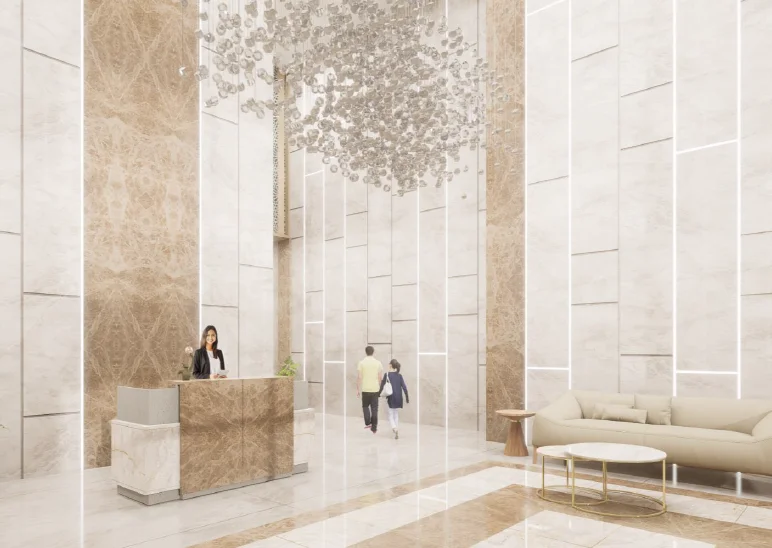
The lobby. The lobby is the handshake. The art in it should read as considered, not lavish. A single large painting, hung at the right height with the right lighting, is worth more than a gallery wall. Most Indian residential lobbies fail on this by hanging too many things too small.
The lift lobby. The lift lobby is a transition space, which means it tolerates a quieter form of art — photography, works on paper, small sculptural details integrated into the wall rather than hung on it. This is the moment where curation can rotate over time, which keeps a residents' daily walk fresh.
The clubhouse. The clubhouse is the informal gathering space and the most forgiving art environment. It can take contemporary work, Indian modernist work, even small editioned pieces that the residents themselves are invited to engage with.
The landscape. The landscape is where residential projects most often fail. A thirteen-acre site plan is, among other things, a sculpture park waiting to happen. The walking loop, the Oxygen Parks, the clearings — each is a potential site for outdoor work at residential scale.
The corridor. The least discussed and possibly most important. The corridor between the lift and the apartment door is the last piece of the building a resident touches before home. A single photograph per floor, thoughtfully framed, transforms this walk from institutional to domestic.
What Fab Luxe signals
Forbes Fab Luxe Residences is unusual in the Indian market in that its naming and design grammar already read as curated. The decision to name the eleven towers after the rivers of the subcontinent — described in our essay on the towers of Fab Luxe — is, in effect, a curatorial decision. It sets a cultural frame within which art, landscape, signage and wayfinding must coherently read. A tower named Ganga cannot be fronted by generic corporate sculpture. The naming forces the next decision.
The 13-acre site plan, organised around Oxygen Parks and microforests rather than podium lawns, is an art-ready landscape. The clubhouse programme, spread across a floor plate dedicated to residents' use, is an art-ready interior. The decision to cap density at four homes per floor creates corridors and lift lobbies with enough linear wall and enough finished width to support art hanging at proper scale. These are planning decisions. They are also, in effect, curatorial permissions.
The detailed art programme for the project will reveal itself closer to possession in December 2028. What the architectural brief already signals is that the project has been designed to carry a serious art programme, not to accommodate one retroactively. For a cover reading of the full brief, our complete guide is the starting point.
Art and the Indian luxury buyer
A quieter observation: the luxury buyer in Delhi-NCR in 2026 has travelled. They have stayed at Aman Tokyo, at the Upper House in Hong Kong, at Claridge's after its refurbishment. They know what a residential hotel experience feels like when art is integrated into the building rather than hung on it. They know the difference between the branded hotel lobby and the curated one. Their mental comparison set, when they walk a residential project in India, is not the last NCR launch. It is the last hotel they stayed at. This is the standard the serious Indian developers are now being judged against.
This is also why the generic "artist impression" renders — a glossy oil painting of the tower, framed in the lobby — read so poorly to this buyer. They signal a developer who is still thinking at the level of marketing, not at the level of clubhouse programming. A buyer who has walked through the Aman in Tokyo does not want their lobby to feature a painting of their own building.
Curation as a long game
The best residential art programmes understand that they are a long game. The first five years of a project, the art is curated by the developer. The next fifty years, if the programme is built right, the residents become the curators. They donate, commission, rotate, argue about the next piece. The walls evolve. The building gains a layer of story that no developer can install.
This requires a few architectural decisions at the start. Large finished wall surfaces that can take rotating work. Lighting tracks that are flexible enough to accommodate different scales. A culture in the residents' association — encouraged by the developer's handover — that treats the common art as a shared asset. Projects that do this well compound in character over decades. Projects that do not, age.
The frame matters as much as the work
A final observation, narrow but important: the frame matters as much as the work. A well-chosen stone floor is the frame for the sculpture above it. The wall colour is the frame for the painting on it. The acoustic quality of the space is the frame for the experience of looking. A piece of art in a reverberant, shiny lobby reads differently — worse — than the same piece in a hushed, matte-finished one. This is why the acoustic discipline of a residential project is also, quietly, an art discipline. Silence is what makes looking possible.
At Fab Luxe, the specification reads as designed for this kind of looking. The finishes are calm rather than busy. The stone is allowed to show its grain. The timber is not painted over. The lighting is warm and directional rather than flat and fluorescent. These are the preconditions for a residential art programme to work. The programme itself will follow.
The test of a curated building
The test, ten years after possession, is whether residents bring their out-of-town friends to the lobby before the apartment. In a successful project, they do. The building becomes part of the story they tell. The sculpture at the approach becomes the thing they describe in the car. The painting in the clubhouse becomes the thing they sit near when they have an argument to settle. The corridor photograph becomes the thing they notice has changed when it rotates.
Forbes Fab Luxe Residences is being built with that ambition. Whether it delivers will be decided not in 2028 but in 2038, when the programme has had time to compound. What is already visible in the brief is that the developer has understood what art in architecture is for. It is not decoration. It is the slow, quiet, cumulative work of making a building feel like a place rather than a product.