
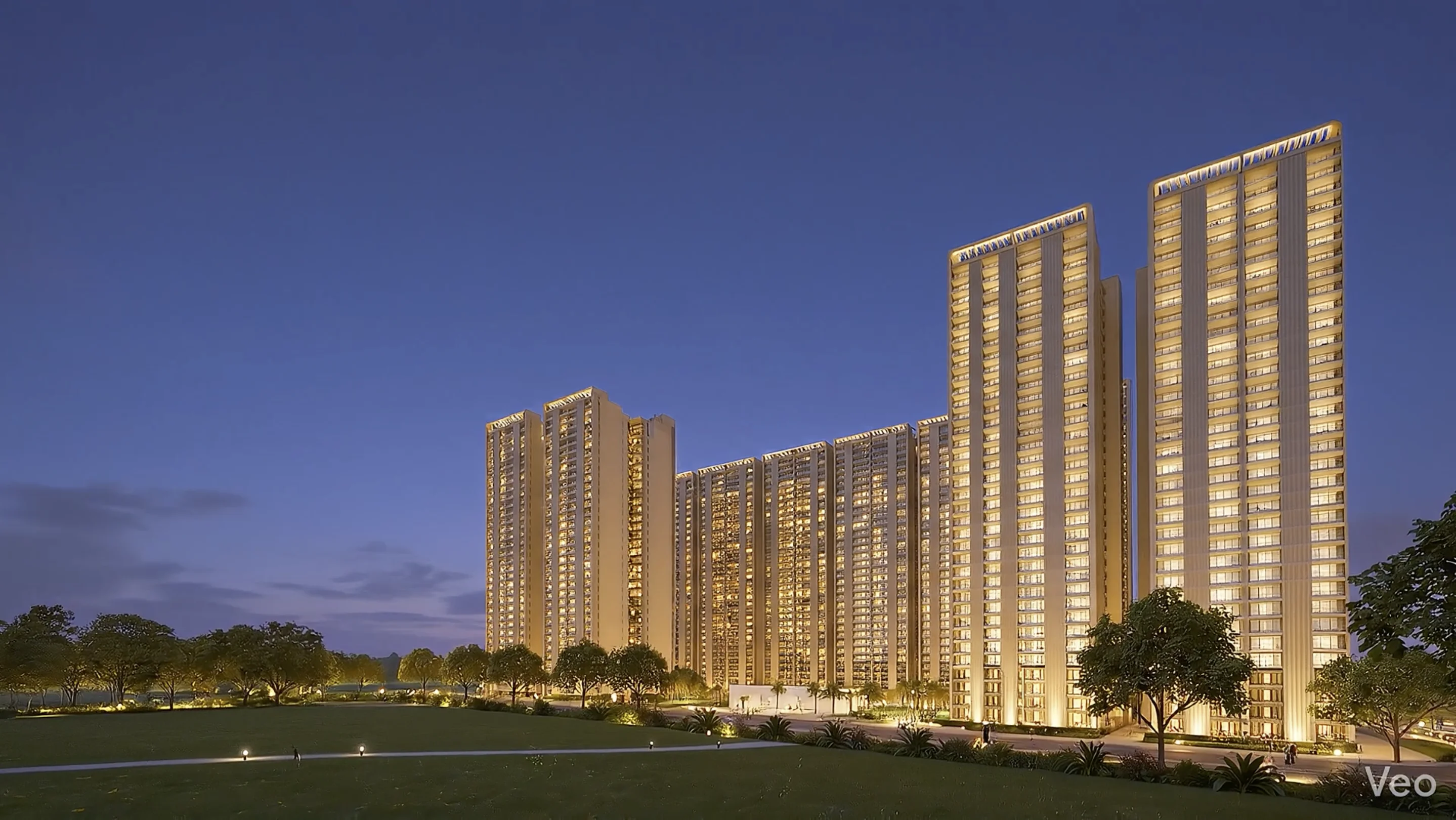
In 2026 the Indian luxury homebuyer is making a purchase decision whose consequences will unfold over a fourteen-year horizon at minimum. The apartment bought this year at Forbes Fab Luxe Residences will hand over in December 2028, settle into use through 2029-30, and spend the bulk of its functional life between 2030 and 2060. The home has to work in 2040. It has to work in 2045. It has to still feel current in 2050. Designing for that horizon is a different discipline than designing for the sales cycle.
This essay is a design brief for that longer horizon — the question of what it means to future-proof a luxury residence in India today, and how the choices available to buyers in 2026 will read in fifteen years.
The four forces that will reshape the Indian home by 2040
Four trends, each already underway, will structurally change what a luxury home has to deliver by 2040.
Climate. The Delhi-NCR region is already warming. Summer peaks of 47°C will become more frequent. Air quality, despite regulatory pressure, will remain among the worst in the world in absolute terms through at least the 2030s. Water stress will increase. The home that is liveable in July 2040 is a home whose envelope, water strategy, and air infrastructure were specified for climate conditions that are worse than today's.
Remote work and hybrid life. The post-pandemic shift has permanently rewritten what a residential floor plan is asked to do. The home is an office, a school, a gym, a social space, a creative studio, a wellness clinic, and occasionally a place to sleep. A 3 BHK in 2040 that has only three bedrooms and a living room is a 3 BHK that has failed at its brief. A home that includes a genuine study — enough for two monitors, a scheduled video call and a private door — is a home that has read the future correctly. This is why the Fab Luxe 3 BHK + Study at 2,690 sq ft and the 4 BHK + Study at 3,307 sq ft are specified the way they are.
Ageing and multigenerational living. The demographic wave is unmistakable. Indian luxury households in 2040 will more often include elderly parents, sometimes adult children, sometimes both. The home that works is the home that is, in the architectural sense, accessible — wide corridors, step-free thresholds, a bedroom on the primary floor, bathroom fixtures sized for future grab bars, ramps that can be added without demolition.
Technology and energy. The home of 2040 will consume electricity differently — electric vehicles in the parking, induction in place of gas, heat pumps in place of air conditioning for much of the year, solar on every viable roof surface. A home whose electrical distribution was sized for the load profile of 2015 will struggle. A home specified for tomorrow's load profile will age gracefully.
The envelope decides everything
The building envelope — walls, windows, insulation, facade — is the decision that compounds the longest and is the hardest to retrofit. A home with a thin envelope will become, in the 2030s, a home that runs its air conditioning for seven months a year and still fails to stay comfortable. A home with a serious envelope will need meaningful air conditioning for three months and pass the other nine with passive comfort.
The Fab Luxe envelope reads correctly for the 2040 climate brief. UPVC insulated double-glazed windows across the project deliver the thermal and acoustic sealing that single-glazed aluminium simply cannot match. The deep balconies shade the primary glazing in summer, reducing solar gain. The narrow floor plates allow cross-ventilation — a passive cooling strategy that becomes more valuable as electricity prices rise. These are envelope decisions that will still be paying dividends in 2045.
Air as long-term infrastructure
Air quality in the NCR, whatever the long-run trajectory, will be the defining liveability variable for the next two decades. A home that has solved for air is a home that gains liveable months every year. A home that has not is a home whose residents spend winter indoors with purifiers on casters, breathing recycled air.
The twin-stage HEPA and activated-carbon fresh-air system specified in every room at Fab Luxe is, in the long view, the most valuable single piece of infrastructure in the apartment. It will be more valuable in 2035 than it is today, because the ambient air will be worse and the market's appetite for homes that manage air will be higher. Our wellness architecture essay makes the broader case. In the 2040-proofing frame, the AQI infrastructure is the single most future-proof feature of the project. Our dedicated piece on acoustic privacy reads similarly — sound insulation ages into value rather than out of it.
Power and the electric home
By 2040, the typical Indian luxury household will own at least two electric vehicles, will cook primarily on induction, and will likely have transitioned from split-unit air conditioning to central heat-pump systems. The electrical load in the apartment will be materially higher than it is today, and the load curve will be different — evening charging, variable solar, two-way grid interactions.
A home designed for this future needs electrical infrastructure with headroom. Larger-gauge wiring. Distribution boards with spare capacity. EV-ready parking conduits at the building level rather than installed after-market. A basement or podium capable of hosting charging stations for every home. At the project level, Fab Luxe is specified for EV charging at residents' parking, and the distribution design carries forward the per-unit capacity needed for the 2040 load. A buyer who plans to live in this apartment for thirty years will never need to call an electrician.
Technology that can be replaced without walls being broken
The worst kind of "smart home" is the one designed around a proprietary control system that is obsolete within five years and cannot be swapped without destroying the wiring. The best kind is designed as a layer on top of standard infrastructure, so that the motorised blinds, the lighting protocol, the air-quality sensors and the entry-control system can each be upgraded independently as the standards evolve.
Our essay on smart home technology takes this argument further. The short version: the future-proof home is a home whose walls are wired correctly and whose devices are allowed to change. At Fab Luxe, the approach is described exactly this way — infrastructure first, devices layered above.
The accessibility question
Nobody enjoys thinking about the home they will need in their seventies. The luxury buyer in 2026 would rather think about the bar counter. But the bar counter is a ten-year feature. The accessibility of the home is a thirty-year feature.
Accessibility done well is invisible in 2026 and decisive in 2046. A 1.2 metre minimum corridor width. A step-free transition from living to balcony. A primary bathroom whose door is wide enough for a wheelchair turn, even if no wheelchair ever enters. Bathroom walls reinforced behind the plaster so that grab bars can be installed without opening structure. A primary bedroom on the same level as the living room. An elevator capable of receiving a stretcher. These are small decisions. They compound.
The Fab Luxe spec sheet reads correctly on most of these by virtue of its larger footprints. A 2,690 sq ft 3 BHK naturally has the corridor width. A 3,307 sq ft 4 BHK naturally has the bathroom geometry. Serviced-residence-adjacent amenities, described in our serviced residences essay, add another layer — home-delivered care, concierge-arranged mobility, in-campus medical support — that materially improves ageing in place.
The hardest future-proofing: community
The most difficult dimension to future-proof is also the most important. It is the question of who your neighbours will be in 2040. A project with thoughtful amenities, a curated resident mix, and a governance structure that maintains standards is a project that ages into a community. A project without those things ages into a building.
Fab Luxe, with 632 residences across 11 towers, is sized so that a community is possible without being overwhelming. The clubhouse programme is designed as a social infrastructure, not just a feature set. The NBCC-monitored, Supreme Court-overseen construction discipline signals a developer culture that will not cut corners under cost pressure. These are the preconditions for a well-aged residents' culture fifteen years from now.
The brief, in one sentence
Future-proofing a luxury home in India in 2026 is, finally, a simple brief to state and a difficult one to execute. Specify for a climate worse than today's, for a household that works from home and ages in place, for an electrical load you have not yet met, and for devices that have not yet been invented. Specify for silence, for light, for air, for water. Specify the envelope like you will never open it again, because you will not. And specify the community, through the choice of developer and the discipline of the construction process, because you cannot specify it yourself.
For the complete reading of how the Fab Luxe project answers this brief, our cover essay is the reference. The short version: the project has been designed for 2040, not 2028. That is the definition of luxury in residential real estate — the capacity to still feel correct in a future that is still unwritten.